Introduction
The prompt for this document was the idea of looking at which states are doing RHTP work with Veterans in their published narratives. I was able to do that, based on a text-based review of the docs. In taking a closer look at all of the documents I’ve collected in the context of my Rural Health Transformation Grant Tracker project, including publicly available webinars, RFPs, vendor lists, LOI submissions, and so on, a more fulsome picture emerges.
This document organizes all of this the evidence via two lenses:
- Supply: what states wrote into their own plans
- Demand, how Veterans surface in the actual applications and in the pool of vendors and potential grantees
As this 5-year program moves forward, the demand side is where there may be opportunities to help shape program design and spending at the state level.
One fact for context: the RHTP is rebuilding the same rural hospitals, clinics, EMS, and telehealth networks where 4.7 million rural Veterans get care and where VA already pays community providers more than $36 billion a year. Only one state — Nebraska — has proposed wiring the two together.
Supply: direct mention in state planning (4)
Nebraska
NE Final Project Narrative RHTP 2025
$2M/yr (proposed estimate; no BP1 figure stated)
Initiative 2.4, “Veteran EHR Coordination,” partners with the VA to integrate the External Provider Scheduling (EPS) system into up to 72 rural facilities (CAHs, RHCs). It prioritizes by claims data on where Veterans receive care, with an outcome metric of the “number of veterans using EHR to schedule appointments outside the VA.”
Nevada
NV Rural Veteran Health Transformation RFA
$2,384,094 (BP1)
A dedicated “Rural Veteran Health Transformation” RFA with eligibility limited to the Nevada Department of Veterans Services. Applications closed 4/30/2026, and while decisions were promised by 5/15/2026, no award has been published.
Wisconsin
WI DHS RHTP Application Narrative
$2,000,000 (one-time, proposed)
Includes private telehealth rooms at the state’s County and Tribal Veterans Service Offices, administered by the Wisconsin Department of Veterans Affairs (the only state Veterans agency named as an RHT recipient).
Texas
TX Rural Health Transformation Program
None stated (scheduled for Year 2 / BP2)
Mentions an intergovernmental agreement with the General Land Office to provide advancements to rural veteran nursing homes, included as a single sentence within a cybersecurity initiative (Initiative 5).
Supply: mention Veterans in passing (18)
These carry no funded Veterans work — a demographic figure, a payer-mix line, a facility inventory, a stock population list, or workforce language. The exact reference and its category:
| State | Type of mention | Verbatim reference | Source |
| Alabama | CCBHC target-population list | “chronic disease patients, deserving veterans, and individuals in medically underserved areas.” | ARHTP Project Narrative |
| Alaska | Demographic | “veterans make up about 10% of the adult civilian population in the state, the highest rate among all states.” | AK RHTP Project Narrative |
| Florida | Payer list (TRICARE, not VA; “veteran” appears zero times) | “…Medicare, Medicaid, CHIP, TRICARE, insurance plans, AARP plans… or any other federal, state, or local programs” | FL RHTP Grant Application |
| Hawaii | Facility name (not a VA facility) | “Kauai Veterans Memorial Hospital” | Engage Hawaii RHTP |
| Idaho | Rhetorical line | “Idaho’s rural families, farmers, veterans, and seniors deserve local, community-rooted care, not permanent government expansion.” | Idaho DHW RHTP |
| Illinois | Payer-mix statistic | “…1% by military or Department of Veteran Affairs (VA)…” | IL RHTP Program Narrative |
| Maine | Stakeholder list + CCBHC boilerplate | “…Veteran’s Administration (current mobile vans)…”; CCBHC “places special focus on service members and veterans” | Maine DHHS Rural Health |
| Michigan | CCBHC “mandatory population” (inside a funding line) | “…services tailored to mandatory populations such as active-duty military and veterans.” | MI RHTP Project Narrative |
| New Hampshire | Demographic comparison | “Rural rates are higher than non-rural rates for… veteran status (by 13%).” | NH RHTP Project Narrative |
| North Carolina | Need statistic | “the second-highest number of rural veterans in the nation (about 730,000)” | NC RHTP Application |
| North Dakota | Specialized-population list (behavioral health) | “This includes individuals reentering communities after incarceration, veterans, students, and families.” | ND RHTP Project Narrative |
| Oklahoma | Braided-funding stream (aspirational) | “…braided funding that integrates streams including Medicaid, FTA Sections 5310 and 5311, the U.S. Department of Veterans Affairs (VA), Tribal transit…” | OK RHTP Project Narrative |
| Pennsylvania | Target-population list + partner list | “Target populations include older adults, individuals with disabilities, veterans, pregnant women…” | PA Rural Health Transformation Plan |
| Rhode Island | Governance seat | “Participating entities include… Office of Veterans’ Services (OVS)…” | RI RHTP Project Narrative |
| South Dakota | Facility inventory + CCBHC boilerplate | “…three Veterans Administration hospitals, four IHS hospitals…” | SD RHTP Project Narrative |
| Vermont | Facility inventory table | “Veterans Affairs Hospital 1 1 0” | VT RHT Project Narrative |
| West Virginia | Workforce law (existing state policy, not RHTP-funded) | “the State has passed legislation to allow qualified military medics to receive recognition for paramedic licensure in West Virginia, expanding the EMS workforce” | WV Project Narrative |
| Wyoming | Payer/demographic (TRICARE & VA) | “Warren Air Force Base and the associated military retiree community in Cheyenne increases the urban percentage of VA and TRICARE.” | WY Final Application |
Two of the eighteen point somewhere useful: West Virginia’s military-medic-to-paramedic pathway is the closest thing to a Veterans workforce channel in any of the eighteen (though it is pre-existing state law, not RHTP-funded), and North Carolina’s 730,000 rural Veterans is the strongest unacted-on need statement. The other sixteen are scenery.
Supply: no mention of veterans (28)
Arizona, Arkansas, California, Colorado, Connecticut, Delaware, Georgia, Indiana, Iowa, Kansas, Kentucky, Louisiana, Maryland, Massachusetts, Minnesota, Mississippi, Missouri, Montana, New Jersey, New Mexico, New York, Ohio, Oregon, South Carolina, Tennessee, Utah, Virginia, Washington.
Two are worth naming because the argument is already in their own plans: North Carolina cites “the second-highest number of rural veterans in the nation (about 730,000)” and proposes nothing; Alaska cites the highest Veteran share in the nation and proposes nothing.
Demand: the Veteran voice in application data published Alaska
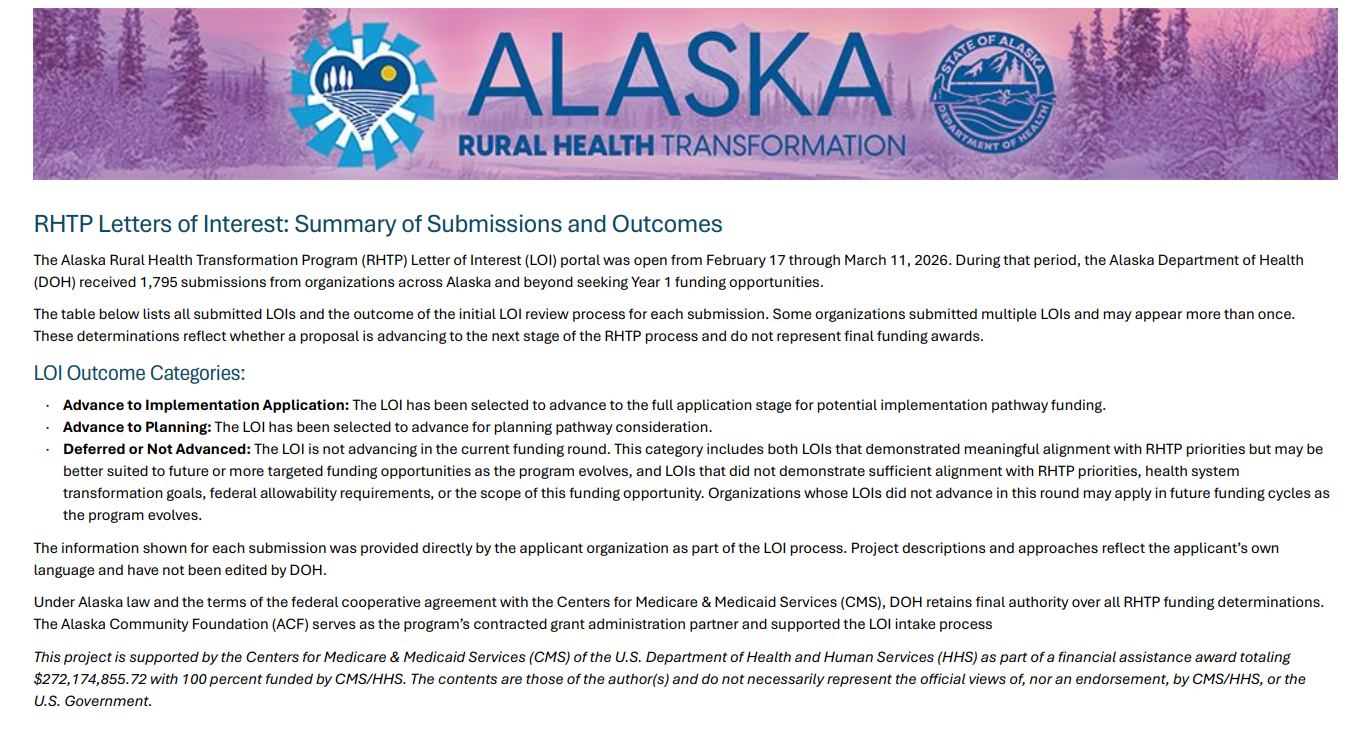
Alaska is the only state whose applicant pool is visible. It solicited and published 1,787 Letters of Intent. Of those, seventeen substantively involve Veterans. Six advanced to an implementation application, eleven were deferred. Outcomes below are the state’s, recorded in the Alaska RHTP LOI tracker; “Advanced” means advanced to an implementation application, not funded.
| Applicant | The Veteran element of the proposal | Outcome | Funding band |
|---|---|---|---|
| Southeast Alaska Independent Living (SAIL) | Participant-directed care that “keeps veterans home” instead of nursing homes ($40K/yr vs. $334K–$436K/yr); cites Alaska’s nation-leading Veteran concentration. The most Veteran-centric LOI in the pool. | Advanced | $50K–$250K |
| Aleutian Pribilof Islands Association | Renovated space to host “Elder case management and Veteran suicide prevention services.” | Advanced | $50K–$250K |
| Orca Labs | Dementia-care pilot whose technology partner (Alula / Vestality LLC) is service-disabled-veteran-owned. | Advanced | $250K–$1M |
| Alaska Stroke Coalition | Adds JBER as a referral site for “rural Alaskans who move through military and veteran systems.” (JBER is a DoD installation, not VA.) | Advanced | $250K–$1M |
| Knik Tribal Council | “Veteran support services” named in the hub’s service list. | Advanced | $1M–$5M |
| North Star Behavioral Health | “Specialized services for veterans and first responders” cited as evidence of statewide-hub status. | Advanced | $1M–$5M |
| Wisdom Traditions (Generative Healing) | Veterans named in the title; built around trauma, “military sexual trauma (MST),” and “veteran specific services.” | Deferred | $1M–$5M |
| AMC Health | The only applicant in all 1,787 describing an operational role inside a VA program: “eight years… supporting Veterans through the VA Home Telehealth Program.” | Deferred | $1M–$5M |
| Catholic Social Services | Proposed a formal referral pathway from the Supportive Services for Veteran Families (SSVF) program. | Deferred | $250K–$1M |
Seven additional LOIs name Veterans only within a list of populations, referral sources, or coverage rules (Altair Community Health, Fairbanks Rescue Mission, Bee Well Chiropractic, Innovation Horizons, Jilkaat Kwaan Heritage Center, Mo On the Go Transport, Tanana Chiefs Conference). Three further “veteran” matches meant seasoned — a veteran consultant, a veteran educator, a 27-year FAA veteran — and are excluded.
As more states publish application data, we can track more Veteran demand for RHTP funds.
Demand: vendors and potential grantees
Another way to track demand is via vendor lists published by states. Organizations positioned to serve Veterans with RHTP money. Note the distinction: state agencies named in plans are near-certain recipients; vendors that self-registered on state directories or interest lists have not been selected.
| Organization | What we know | State | Link |
|---|---|---|---|
| Wisconsin Department of Veterans Affairs | Named RHT award recipient; administers the $2M Veterans telehealth line. | WI | dva.wi.gov |
| Nevada Department of Veterans Services | Sole eligible applicant for the $2,384,094 Veterans RFA. | NV | veterans.nv.gov |
| Rhode Island Office of Veterans Services | Holds a seat in Rhode Island’s RHTP governance structure. | RI | vets.ri.gov |
| Providence VA Medical Center | Named as an RHTP stakeholder / HIT infrastructure prospect in Rhode Island; five clinical and engineering staff identified. | RI | va.gov |
| Mountain Veteran Solutions | Veteran-owned rural health data/IT vendor; self-registered on Montana’s vendor directory. | MT (self-registered) | mountainvetsolutions.com |
| Arise Veteran Foundation | Clinical and social care coordination for Veterans and Alaska Native/American Indian families; self-registered, Montana. | MT (self-registered) | arise-veteranfoundation.org |
| Veterans Navigation Network | Rural Veteran resource navigation, case management, peer mentorship; self-registered, Montana. | MT (self-registered) | veteransnavigation.org |
| Lakeraven, LLC | Native-owned, veteran-led digital services consultancy; on Oregon’s RHTP vendor interest list. | OR (vendor list) | lakeraven.com |
| Televeda | Reduces isolation in “rural, Tribal, women, Veteran, and historically underserved communities”; on Oregon’s vendor list. | OR (vendor list) | televeda.com |
| Source One Serenity | Veteran purpose-and-recovery through land stewardship; on Oregon’s vendor list. | OR (vendor list) | sourceoneserenity.org |
Caveats
- Nothing has been awarded to a Veterans-serving entity in any state. Every figure above is proposed, fenced, or self-registered — none obligated.
- Nevada’s award is unpublished as of July 17, two months past its own 5/15 decision deadline. Unpublished is not unmade; the question is open. RHTP@nvha.nv.gov.
- Nebraska and Wisconsin dollars are estimates in applications, not obligations. Neither has released a Veterans procurement. Nebraska’s document states no Budget Period 1 figure.
- Texas is one sentence inside a cybersecurity initiative, scheduled for Year 2. The terms “Veterans Land Board,” “Texas State Veterans Homes,” and “Interagency Cooperative Agreement” do not appear in the source; they are inferences that circulate in trackers.
- Alaska’s deferrals were not necessarily deferred for being Veterans work. No scoring rationale is public; LOIs competed on many dimensions. The defensible statement is only that Veterans work arrived unsolicited and none advanced at scale — including the one applicant already inside a VA program.
- Vendor self-registration is not selection. Appearing on a state directory or interest list confers no award or endorsement.